


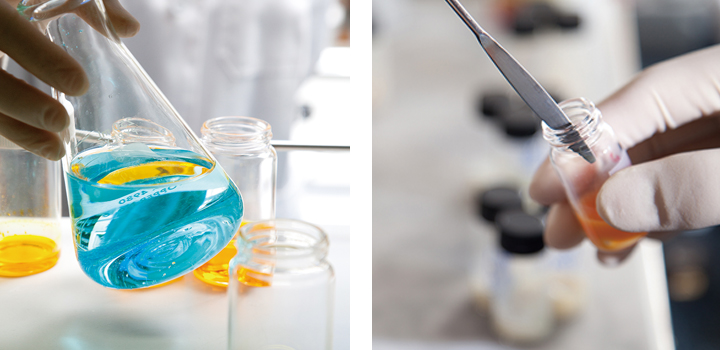
The Department of Chemical and Bioloecular Engineering has been one of the best chemical and biomolecular engineering departments in Asia. |
The Department of Chemical and Biomolecular Engineering has been one of the best chemical and biomolecular engineering departments in Asia. It has an illustrious history in sharing the tradition of truth and freedom. And it has provided national leadership in engineering education throughout the development of the nation. The Department offers programs of research and teaching spanning the breadth of chemical engineering with unprecedented depth in the areas of fundamental and applied importance. The Department's strong record of achievement is solidly based on its continuing record for pioneering advances in engineering sciences and technologies, its ability to relate new development and advances in engineering practice, its success in incorporating these advances into teaching and research programs, and its close relationship with industry.
The Department of Chemical and Biomolecular Engineering was first founded 1950 in the name of industrial Chemistry Department, which was oriented mostly toward applied and industrial chemistry. Its name was later changed to the Department of Chemical Engineering with the modern concept of unit operation and process design in 1956. Presently, the Department is comprised of 17 faculty members including three emeritus professors, about 150 full-time graduate students, and 400 undergraduates. In 2008, its name was late changed to the Department of Chemical and Biomolecular Engineering to emphasis on the biochemistry field.
Its alumni have distinguished themselves in positions of responsibility and leadership in industry, government, and academia throughout Korea and abroad. At present, about half of them are working at industries and research institutes. These graduates have also contributed a great deal to the development of the Department as well as in the preservation of the tradition of Yonsei University as a high-ranking private university.
In order to qualify for the B.S. degree in the Department of Chemical and Biomolecular Engineering, a student should take 62 credit hours of major courses listed below. The courses in the Department of Chemical and Biomolecular Engineering provide students during the sophomore year with fundamentals of chemical engineering science such as physical chemistry, organic chemistry, and analytical chemistry. Based on these fundamentals, students in their junior and senior years are provided with training in applied chemical kinetics, engineering thermodynamics, transport phenomena, biochemical engineering, process analysis and control, environmental engineering, separation processes, and polymers. Therefore the students in the chemical and biomolecular engineering program are equipped for professional work in the development, design, and operation of chemical processes and of process equipments. Student with high scholastic aptitude are well prepared to enter graduate programs.